
2026/10/31(Wed.) Forum : De-colonial Pedagogies:Weaving Communal Care into Embodied Cultural Praxis
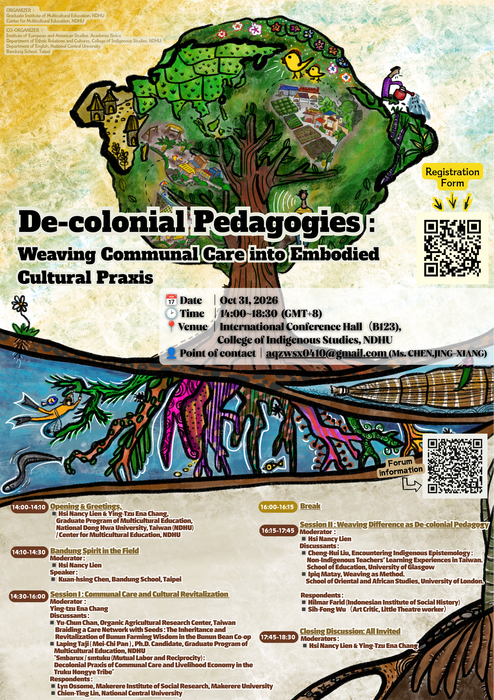
//De-colonial Pedagogies:Weaving Communal Care into Embodied Cultural Praxis//
🔸 Introduction:
In 1955, Indonesia hosted the inaugural Bandung Conference, expressing the Third World’s resistance against global capitalist expansion and exploitation while advocating for a more just and equal world. Seventy years later, the "Bandung Spirit" symbolizes the transcendence of the world order built upon Euro-American colonial systems. It prompts a re-examination of the colonial conditions of the Global South across Asia, Africa, and Latin America, thereby opening a historical horizon of international decolonization and weaving a liberating pedagogy of people solidarity.
As global economic hardships limit local livelihood options, rural schools in Eastern Taiwan, also coinciding with Indigenous regions, face downsizing and closures. Simultaneously, mainstream education promotes individual achievement and capitalist competition, reinforcing systems of colonization. This schooling makes children strangers to their own communities; they lose their native languages, traditional craftsmanship, and connection to a land-based way of life. Consequently, the more formal education rural youth receive, the more disconnected they become from their local heritage, accelerating community fragmentation and youth out-migration.
Faced with this dismal backdrop, we must ask: What kind of education truly serves rural and Indigenous communities and strengthens social resilience? Historically, subaltern home places have served as sites of resistance against modern oppression. By embracing collective learning and indigenous wisdom, marginalized communities can actively decolonize their education and reclaim their presence in history.
In light of the Bandung Spirit, we anchor this forum in the solidarity and local practices of the people. Embracing contextual differences and hybridity, we seek to forge pathways for decolonization. This forum invites Indigenous cultural praxis initiatives that foster community-based, participatory action research that unites indigenous populations, farming villages, and researchers. Instead of taking Indigeneity as legally defined in Taiwan, we examine Indigenous experiences at the juncture of colonized peoples, regional development tenacious relationship with capitalism, and cultural sovereignty. Through decolonial pedagogies grounded in local knowledge, we look forward to deepening our shared understanding of current crises, build solidarity, and turn grassroots empowerment into a force for genuine social innovation.
🔸 Event Date and Location:
⬠ Date:October 31 (Saturday), 2026
⬠ Time:2:00 PM - 6:30 PM
⬠ Location:International Conference Hall(B123), College of Indigenous Studies, NDHU
🔸 Registration Form : https://reurl.cc/QNApr0
🔸 Registration Deadline : 2026/10/28
🔸 Notice:
Submitting this form completes your sign-up; no separate confirmation will be sent. If registration reaches capacity (maximum of 20 participants), places will be allocated in the order registrations are received, and those not accepted will be notified separately by email. All event updates and changes will be sent by email, so please make sure your contact information is correct.
🔸 ORGANIZER:
⬠ Graduate Program of Multicultural Education, NDHU
⬠ Center for Multicultural Education, NDHU
🔸 CO-ORGANIZERS:
⬠ Institute of European and American Studies, Academia Sinica
⬠ Department of Ethnic Relations and Cultures, College of Indigenous Studies, NDHU
⬠ Department of English, National Central University
⬠ Bandung School, Taipei